
The information contained herein is of a general nature and is not intended to address the circumstances of any particular individual or entity. Although we endeavor to provide accurate and timely information, there can be no guarantee that such information is accurate as of the date it is received or that it will continue to be accurate in the future. No one should act upon such information without appropriate professional advice after a thorough examination of the particular situation. KPMG does not provide legal advice.
© 2026 KPMG LLP, a Delaware limited liability partnership, and its subsidiaries are part of the KPMG global organization of independent member firms affiliated with KPMG International Limited, a private English company limited by guarantee. All rights reserved. USCS036737
For more detail about the structure of the KPMG global organization, please visit https://home.kpmg/governance.
Some or all of the services described herein may not be permissible for KPMG audit clients and their affiliates or related entities.
bmiske@kpmg.com


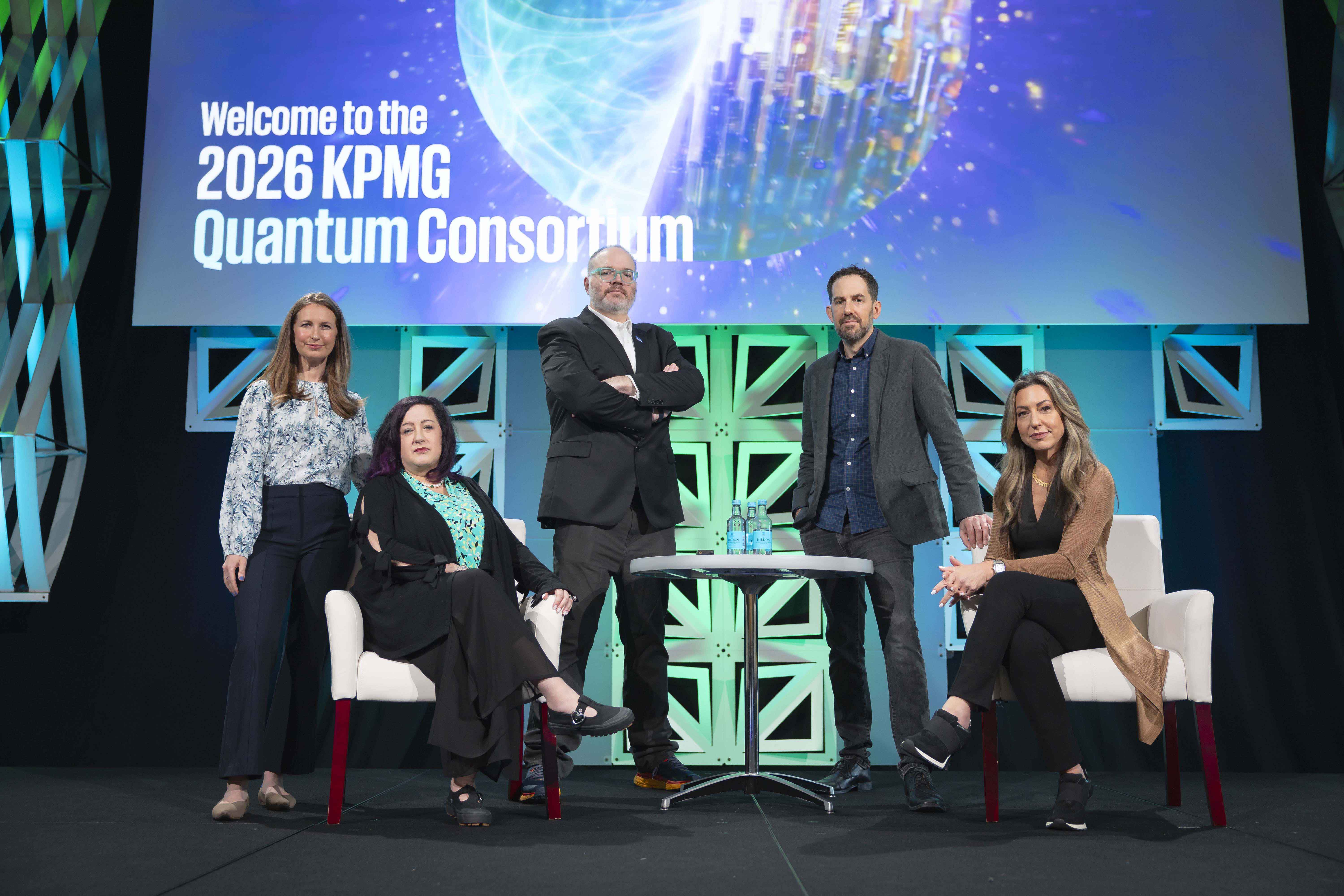
Thank you to everyone who joined us at the 2026 Quantum Consortium event at KPMG Lakehouse.

Thank you for attending!
Session recaps:
Back to top
Consortium
Quantum
March 2–3
KPMG Lakehouse, Orlando, FL
A must-attend event for forward-thinking leaders
2026 KPMG
Hosts and Speakers
Contact our Quantum Leaders to learn more

Dr. Aaron Kemp
Senior Director,
Quantum Research,
Enterprise Innovation�KPMG US

Richard Entrup
Managing Director, Enterprise Innovation Head of Emerging Solutions�KPMG US

bmiske@kpmg.com


Click here to expand and view the full roster of our distinguised speakers.

Dr. Lekshmy Sankar, KPMG US
Harvest Now, Decrypt Later
Day 1: Monday, March 2
Ricardo Canedo Mondragón,�Quantum Artist
Spherical Harmony, Quantum Art, and Sound
Dr. Aaron Kemp, KPMG US
Quantum Reality Check
Dr. Lekshmy Sankar, KPMG US
Elisa Holland, KPMG US
Chris Brodkey, KPMG US
Ignition Breakouts: Quantum Computing &�Post-Quantum Crytopgraphy
Dr. Caitlin Carnahan, Infleqtion
Dr. Richard Padbury, BMO
Spencer Topel, Moth Quantum
Richard Entrup, KPMG US
Beyond Compute
Erika Knierim, Founders Law LLC
Fortress or�Glass House
Day 2: Tuesday, March 3
Dani Couger, Lockheed Martin
Dennis Gatens, LEOcloud Voyager Tech, Inc.
Richard Ward, OrbitsEdge, Inc.
Brian Miske, KPMG US
Quantum-Accelerated Space Capabilities
Vincent Beltrani, IBM Quantum
Jonathan Jones, KIPU Quantum
Dr. Aaron Kemp, KPMG US
Optimization Unleashed
Srinivas Prasad Sugasani, �Quantum & AI Microsoft
Engineering the Quantum Future
Richard Entrup, KPMG US�(with contributions from Dr. Aaron Kemp and others)
Closing Statements
Click arrows below to see workshop details.
Quantum computing has totally redefined the rules of business, security, and innovation. Throughout the Consortium, leaders explored how quantum is already transforming everything from cryptography to optimization—and why delaying action now creates real risk.
�The stakes were clear. Discussions highlighted how hackers are actively stockpiling encrypted data for future decryption, while emerging US and EU regulations are accelerating the need for quantum readiness. At the same time, participants examined the upside: breakthrough capabilities that unlock new business models and durable competitive advantage for organizations prepared to lead.
Event highlights
View the event photo gallery
2025 Tech and Innovation Symposium
event highlights
2026 Quantum Consortium photo highlights
KPMG Workshop Sessions

Targeted to CISOs, CIOs, and CTOs with security accountability, along with risk, compliance, and regulatory affairs leaders, this interactive session convened senior technology and security executives to advance practical understanding of post‑quantum cryptography and its enterprise implications.��Participants explored how post‑quantum cryptography is rapidly shifting from a future concern to a present‑day security imperative. The discussion moved beyond theory, grounding quantum risk in real-world enterprise environments and regulatory expectations.��Attendees collaboratively examined why post‑quantum capabilities matter now, how emerging threats could impact cryptographic trust models, and where organizations should begin prioritizing action. Through guided ideation and peer exchange, the group surfaced concrete considerations for integrating post‑quantum readiness across industries, from financial services and critical infrastructure to technology and healthcare.��The session concluded with a shared recognition that post‑quantum preparedness is not solely a technology upgrade, but a strategic, cross‑functional capability—requiring alignment across security, risk, governance, and executive leadership to future‑proof enterprise resilience.

Attendees collaboratively examined why post‑quantum capabilities matter now, how emerging threats could impact cryptographic trust models, and where organizations should begin prioritizing action. Through guided ideation and peer exchange, the group surfaced concrete considerations for integrating post‑quantum readiness across industries, from financial services and critical infrastructure to technology and healthcare.��The session concluded with a shared recognition that post‑quantum preparedness is not solely a technology upgrade, but a strategic, cross‑functional capability—requiring alignment across security, risk, governance, and executive leadership to future‑proof enterprise resilience.
Post-Quantum Cryptography
The information contained herein is of a general nature and is not intended to address the circumstances of any particular individual or entity. Although we endeavor to provide accurate and timely information, there can be no guarantee that such information is accurate as of the date it is received or that it will continue to be accurate in the future. No one should act upon such information without appropriate professional advice after a thorough examination of the particular situation. KPMG does not provide legal advice.
© 2026 KPMG LLP, a Delaware limited liability partnership, and its subsidiaries are part of the KPMG global organization of independent member firms affiliated with KPMG International Limited, a private English company limited by guarantee. All rights reserved. USCS036737
For more detail about the structure of the KPMG global organization, please visit https://home.kpmg/governance.
Some or all of the services described herein may not be permissible for KPMG audit clients and their affiliates or related entities.
Back to top
bmiske@kpmg.com

Dr. Aaron Kemp
Senior Director,
Quantum Research,
Enterprise Innovation�KPMG US
bmiske@kpmg.com

Richard Entrup
Managing Director, Enterprise Innovation Head of Emerging Solutions�KPMG US
Contact our Quantum Leaders to learn more
Read bio

Richard Ward
Founder & CTO
OrbitsEdge, Inc.

Read bio
Param Vig
SVP, Chief Information Security Officer�Solventum

Read bio
Spencer Topel
CTO�Moth

Read bio
Kate Timmerman
Chief Executive Officer
Chicago Quantum Exchange

Read bio
Dr. Lekshmy Sankar
Quantum Security Lead,
Advisory�KPMG US

Read bio
Srinivas Prasad Sugasani �Vice President,
Quantum & AI �Microsoft

Read bio
Katie Pizzolato
Vice President,
Quantum Platform�IBM

Read bio
Richard Padbury
Director of Research BMO

Read bio

Ricardo Mondragón
Artist,�Merging Quantum Physics, Art,�Code and Fabrication

Read bio
Brian Miske
US Ignition Leader, Americas Space Leader�KPMG US

Read bio
Erika Knierim
Partner,�Emerging Tech�& IP Attorney �Founders Law LLC

Read bio
Jonathan Jones
GTM�Kipu Quantum

Read bio

Eric R. Hudson
Professor, Physics�UCLA, AMO, �Hudson Lab

Read bio
Dr. Noel Goddard
Chief Executive Officer�Qunnect

Read bio
Dennis Gatens
President, LEOcloud Voyager Technologies, Inc.

Read bio
Brian Fields
Partner,�Enterprise�Innovation Leader�KPMG US

Read bio
Dani Couger
Quantum Lead,�Lockheed Martin

Read bio
Dr. Caitlin Carnahan
Vice President,�Quantum Software�Infleqtion

Read bio
Barak Bussel
Co-Founder, 7i Capital�Chair, UCLA CQSE

Read bio
Vincent Beltrani
Quantum Global Lead,�GSI & Consulting Partnerships

Speakers
Read bio
Dr. Aaron Kemp
Senior Director,
Quantum Research,
Enterprise Innovation�KPMG US
Read bio
Richard Entrup
Managing Director, �Enterprise Innovation
Head of Emerging �Solutions�KPMG US

Hosts
Vincent Beltrani is the Global Lead for GSI & Consulting Partnerships at IBM Quantum, where he is responsible for building and scaling IBM’s global ecosystem of systems integrators and consulting partners to accelerate enterprise adoption of quantum computing. In this role, he works closely with leading global consultancies to help organizations move from quantum exploration to real-world, industry‑focused�experimentation and long‑term readiness.��Vincent brings a rare combination of deep scientific training and commercial leadership. He began his career as a physicist, conducting advanced research in quantum control, optimization, and feedback systems, and publishing widely cited work in leading scientific journals. He also taught and mentored students in quantum mechanics and laboratory science, earning recognition for excellence in teaching.��He later transitioned into enterprise technology leadership at IBM, where he held roles spanning technical sales, solution engineering, and partner engagement. This background enables him to bridge complex quantum concepts with executive decision‑making and practical business outcomes. Prior to his work in quantum partnerships, Vincent was recognized as Sales Engineer of the Year for Mendix, reflecting his ability to translate advanced platforms into measurable enterprise value.��Today, Vincent is a frequent speaker at global industry events and executive forums, where he focuses on quantum readiness, hybrid classical‑quantum computing, and the convergence of AI and quantum technologies. He is a strong advocate for early enterprise preparation, emphasizing skills, workflows, and ecosystem collaboration as critical foundations for the quantum era.�
Quantum Global Lead,
GSI & Consulting Partnerships
Vincent �Beltrani
Barak Bussel is a serial entrepreneur, investor, and philanthropist. Focused on harnessing scientific innovation into transformative technologies for the advancement of humanity, Barak is managing partner of venture capital firm 7i Capital, which he founded to invest in leading early‑stage companies across areas of global impact including quantum computing, artificial intelligence, cybersecurity, semiconductors, robotics, clean energy, and space.
�A physicist by training, Barak is Chairman of UCLA’s multidisciplinary Center for Quantum Science & Engineering. He helped spearhead the creation of the UCLA Quantum Innovation Hub, a cornerstone of the university’s new billion‑dollar Research Park. The Hub advances quantum information science and technology to address major global challenges in energy, food scarcity, and climate change, and aims to become one of the world’s premier quantum ecosystems.
�For more than two decades, Barak has also served as a managing partner at Third Wave Ventures, a Los Angeles‑based venture capital firm. From 2016 to 2019, he was president of a Third Wave photonics portfolio company developing advanced chips for applications spanning augmented reality and renewable energy. Earlier, he served on the board of machine‑vision pioneer Neven Vision prior to its acquisition by Google.
�Barak holds an MS in Theoretical Physics and an MBA from UCLA, as well as a BS in Theoretical and Mathematical Physics from Harvey Mudd College, and has delivered the commencement address for UCLA Physics & Astronomy graduates. He is fluent in Hebrew and conversant in Mandarin.�
Board Chair,�Co-Founder, 7i Capital�Chair, UCLA CQSE
Barak �Bussel
As the Vice President for Quantum Software at Infleqtion, Caitlin Carnahan oversees the QSW portfolio of programs. In this role, she leverages her experience coordinating and transitioning deeply technical projects to help connect quantum breakthroughs to Government and industry needs.
Caitlin obtained her Ph.D. in Physics from Carnegie Mellon University. Her main research focus was in quantum and classical characterization of spin-mediated transport in topologically non-trivial systems. Before joining Infleqtion, Caitlin was a Principal Scientist in the Detection Systems group at Physical Sciences Inc., working on several computational and machine learning-driven projects in the domain of sensing and data fusion.�
Vice President, Quantum Software Infleqtion
Dr. Caitlin Carnahan
Dani Couger is the Quantum Lead at Lockheed Martin, where she serves as a Technology Domain Program Manager guiding the company’s strategy and investments in quantum information science. With more than a decade at Lockheed Martin, Dani operates at the intersection of applied research, systems engineering, and enterprise‑level technology planning, helping translate emerging quantum capabilities into mission‑relevant solutions for aerospace, defense, and national security.��Dani’s work spans quantum computing, quantum sensing, and non‑computational quantum devices, with a focus on disciplined, systems‑driven adoption of high‑risk, high‑reward technologies. Dani collaborates extensively with academia, national laboratories, and industry partners, and frequently represents Lockheed Martin at leading quantum conferences and forums. She holds a bachelor’s degree from West Texas A&M University, a master’s degree from The George Washington University, and a professional certificate from MIT.
Quantum Lead,�Lockheed Martin
Dani
Couger
Richard Entrup is Managing Director and Head of Emerging Solutions, Enterprise Innovation at KPMG in the US. In his role, he’s focused on emerging technologies or frontiers such as Generative AI, Quantum computing, Spatial computing/immersive learning, Digital Assets/Blockchain/Web3, Space, and others, helping clients explore the art of the possible and how to leverage emerging technology for business value.
Richard has significant experience leading digital transformation and innovation, digital marketing, technology operations, cybersecurity, and data/analytics/AI. Prior to joining KPMG, he led global technology operations, digital transformation, and innovation programs at many prominent global brands including Verizon, Christie’s, Disney/ABC, Time Warner, The Museum of Modern Art, Viacom, and Tiffany & Company. He has also served as a CIO, CTO, CDO, and CISO at several health care companies and an international law firm, with documented success aligning technology investments to strategic business objectives.�
Managing Director, Enterprise Innovation Head of Emerging Solutions�KPMG US
Richard Entrup
Brian Fields is a KPMG partner with a range of experiences as an auditor, advisor, regulator, and transformation leader. He leads the KPMG Audit and Assurance Transformation Team, a cross-disciplinary group of professionals who are responsible for driving the KPMG strategy to enhance the quality, efficiency, insight, and experience of the audit. With experience across many industries and types of companies, Brian enjoys tackling novel challenges and delivering quality outcomes in dynamic environments.
Sitting at the intersection of strategy, AI, data, and execution, Brian helps organizations turn emerging technology into real advantage—from pilots to platforms, ideas to impact. Less theater. More outcomes. Inside KPMG, Brian operates as a builder and translator. Aligning executives, technologists, and professionals to make innovation stick.�
Partner, Enterprise Innovation Leader KPMG US
Brian Fields
Dennis Gatens founded LEOcloud in 2021 and led it to a successful acquisition by Voyager Technologies in 2025. His vision extends cloud services into space with resilient, scalable, multi-cloud managed Infrastructure as a Service (IaaS), supporting the data-driven space economy. In October 2025, Voyager LEOcloud deployed the first operational data center in space aboard the ISS. Dennis anticipates quantum technologies will transform the space economy, starting with quantum-proof security and communications, ultimately leading to quantum computing in space.��Before LEOcloud, Dennis was CCO at Cloud Constellation Corporation, handling global sales, marketing, and strategic alliances. With over 35 years in commercial aerospace and space technology, he excels in introducing emerging technologies through global partnerships. Dennis holds a BS in Electrical Engineering from Virginia Tech and an MBA from Radford University.�
President, LEOcloud�Voyager Technologies, Inc.
Dennis �Gatens
Noel Goddard is the Chief Executive Officer of Qunnect, where she leads the company’s mission to advance quantum technology and enable quantum‑secure communications over existing telecom infrastructure. She joined Qunnect’s management team in 2020, bringing a rare combination of deep scientific expertise, entrepreneurial leadership, and investment experience.��Prior to Qunnect, Noel was a seed investor with the Accelerate NY Seed Fund, where she built and supported a portfolio of deep‑technology and life sciences companies across Downstate New York. She is a serial entrepreneur, having founded and led two biotech startups, and began her career in academia as an assistant professor of physics at Hunter College, CUNY. Noel completed her postdoctoral research as a Fellow at Harvard University and earned her PhD from Rockefeller University. �Her background spans interdisciplinary research, hardware innovation, and company building, with a focus on translating cutting‑edge science into real‑world impact. �Fun fact: Noel was an avid sportbike motorcyclist for 10 years.�
Chief Executive Officer,
Qunnect
Dr. Noel �Goddard
Eric R. Hudson is a Professor of Physics at the University of California, Los Angeles (UCLA), working in atomic, molecular, and optical (AMO) physics and quantum science. His research focuses on trapped-ion quantum computation, precision measurement, and the use of engineered quantum systems to probe fundamental physics. The Hudson group develops novel techniques for trapping, cooling, and controlling atomic and molecular ions, and is pioneering the development of a thorium nuclear clock. Through advances in precision hardware and quantum control, his work aims to push the limits of measurement and control in complex quantum systems.��Hudson is a Founder and Director of the UCLA Center for Quantum Science and Engineering and of the UCLA Master of Quantum Science and Technology program. He leads the National Science Foundation project Accelerating Fault-Tolerant Logic, focused on building a utility-scale quantum computer, and is Co-Director of the NSF Challenge Institute for Quantum Computation. He is a Fellow of the American Physical Society and a recipient of the Presidential Early Career Award for Scientists and Engineers.�
Professor, Physics�UCLA, AMO, Hudson Lab
Eric R. �Hudson
Jonathan C. Jones is a go‑to‑market and growth leader with more than a decade of experience spanning quantum computing, blockchain, deep technology, and aerospace engineering. He currently serves as Go‑To‑Market (GTM) Lead at Kipu Quantum, where he leads commercial strategy for application‑specific quantum computing solutions. ��Prior to Kipu Quantum, Jonathan held senior commercial leadership roles at Siccar, a UK‑based enterprise data‑sharing company built on distributed ledger technology. From 2021 to 2025, he served as Chief Revenue Officer and Growth Lead, where he led revenue strategy, closed the company’s first commercial licenses, helped secure strategic partnerships with multinational enterprises, and supported Siccar’s 2022 fundraising. His work included driving market adoption of secure emissions and ESG data solutions across energy and industrial sectors. Alongside these roles, Jonathan founded JJ Advisory, advising early‑stage technology companies on growth strategy, product positioning, and go‑to‑market execution.��Earlier in his career, Jonathan led business development and product initiatives at Interbit (BTL Group), one of the first publicly traded blockchain companies, driving sales into regulated industries including oil and gas. He also worked at University College London (UCL), managing engineering teams on spacecraft and satellite design projects for ESA and NASA. Jonathan began his career at the Lotus F1 Team in composites production and holds an MEng in Aerospace Engineering from the University of Bristol. �
GTM�Kipu Quantum
Jonathan �Jones
As a Senior Director of Technology Risk at KPMG US, Dr. Kemp leverages his experience in cybersecurity/post-quantum cryptography and over 30 years of�real-world action in information technology and security to deliver high-quality technology risk engagements for various clients.
Dr. Kemp has a proven track record of leading and coordinating internal and external audits, compliance and regulatory assessments, process and technology internal controls, technology security reviews and implementation, and global system implementation reviews across different industries and domains.�
Senior Director,
Quantum Research,
Enterprise Innovation KPMG US
Dr. Aaron Kemp
Erika advises early‑and growth‑stage technology companies from formation through exit on startup and transactional matters. Her work includes founder arrangements, cap table and equity incentive design, multi‑entity structuring (including IP holding companies, operating subsidiaries, SPVs, and fund vehicles), and customer, vendor, and platform agreements aligned to how data, models, and IP move through modern products.
�Drawing on experience as both an emerging‑technology regulatory lawyer and Investment Advisor, Erika represents angels, syndicates, and funds, with an emphasis on clean governance, information rights, and clear exit pathways. She also advises financial and cultural institutions on partnerships with technology companies, from pilots to long‑term collaborations, balancing innovation with risk, compliance, and brand considerations.
�Outside the firm, Erika is the co‑founder and Executive Director of TECHNĒ Chicago, an art‑and‑technology platform producing programs at the intersection of science, culture, and emerging technology. She began her career as an Assistant Public Defender in Cook County, trying more than 300 trials, and later advised on portfolio and wealth strategy at William Blair. Erika is a graduate of Loyola University Chicago School of Law and the University of Illinois at Urbana‑Champaign and is active in Chicago’s cultural community. At home, she is kept in line by her Pomeranian, Mr. Darcy.�
Partner,�Emerging Tech & IP �Founders Law LLC
Erika�Knierim
Brian Miske holds both the Americas Space Lead role as well as continues to Lead KPMG Ignition in the US. With a Master's degree in Space Leadership, Business, and Policy, Brian seeks to help the firm harness opportunities in the rapidly evolving space sector and broader space economy. Brian seeks to be an inspiring transformational leader leveraging innovation, strategy, and creativity to navigate complex challenges in organizations and society.
With a stellar track record as a Principal at KPMG and a valued Board Member of the Association of Commercial Space Professionals (ACSP), Brian is dedicated to lifelong learning and immersed in emerging fields like Innovation, Commercial Space, Law and Policy, as well as AI and Machine Learning. Working hand in hand with company executives, industry leaders, employees, and external partners, Brian continuously strives to compete and collaborate in a market of ever-evolving disruption.�
US Ignition Leader, Americas Space Leader�KPMG US
Brian�Miske

Ricardo Canedo Mondragón is a London based artist whose work explores how concepts from quantum physics such as superposition, interference, correlation, and field behavior can be translated into spatial and material form. His practice investigates how structure emerges from interacting systems, focusing on vibration, wave dynamics, and the mathematical conditions that give rise to complex geometry.
Trained in music composition in Chicago, he began with research on sound and harmonic systems before expanding into sculpture and spatial environments. Working at the intersection of art, science, computation, and fabrication, he derives sculptural forms from equations and parametric systems, realized through CNC milling, 3D printing, and casting.
�He has collaborated with Fermilab, the Museum of Contemporary Art Chicago, and the Chicago Symphony Orchestra. He is currently completing an MA in Sculpture at the Royal College of Art in London and lives and works in London.
�
Artist,�Merging Quantum Physics, Art, Code and Fabrication
Ricardo�Mondragón
Building enduring relationships is one of Richard Padbury’s greatest passions: through it Richard has learned that the best outcomes are achieved when we learn from those who are different from ourselves, in an environment that promotes inclusivity and values all inputs.
Richard has worked in the Raleigh-Durham area for more than 10 years which has allowed him to build networks with organizations across academia, government and industry in Research Triangle, as well as nationally and abroad. Richard thrives on making new connections and bringing together experts from different backgrounds to explore collaborations that are mutually beneficial and have meaningful impact on society.�
Director of Research�BMO
Richard�Padbury
Katie Pizzolato leads a team of Quantum Computing Researchers whose work encompasses everything from the fundamental to the practical of quantum computing, all in pursuit of demonstrating quantum advantage. She is also responsible for academic and industry partnership research within the IBM Quantum Network.
Katie has extensive technical and engineering leadership and development experience, including roles such as Program Director for Systems Development and Design, and Packaging Lead in the IBM Systems Group. Katie has a well-established track record of defining and executing strategies in new fields.�
Vice President,�Quantum Platform�IBM
Katie�Pizzolato
Srinivas Prasad Sugasani is the Vice President Quantum & AI at Microsoft. He leads a team focused on accelerating business growth and delivering the world's first Quantum computer. His role involves strategic product leadership and collaborating with world-class quantum scientists and engineers across multiple disciplines. He is also involved in building the world's first scalable Quantum Computer and AI-powered software applications to accelerate scientific discovery.
Srinivas's work at Microsoft is highlighted by his participation in the QuNorth and Magne events, showcasing his commitment to advancing quantum technology and AI. He has been instrumental in the development of the Microsoft Quantum Development Kit (QDK), which represents a significant step towards full-stack Quantum computing.
�His dedication to technology and innovation is evident in his role at Microsoft, where he plays a crucial part in shaping the future of quantum computing and AI. His leadership and contributions have been recognized with numerous accolades and awards, reflecting his impact on the field.
Vice President,�Quantum & AI �Microsoft
Srinivas
Prasad Sugasani
As a cybersecurity executive and a leader in post-quantum cryptography (PQC), Dr. Sankar helps Fortune 500 enterprises prepare for the most significant encryption transition in history. With CNSA 2.0 mandating quantum-safe systems by 2030-2033 and "harvest now, decrypt later" attacks already underway, Dr. Sankar guides organizations through cryptographic inventory, risk assessment, and PQC migration strategies.
With 20+ years navigating the dynamic world of IT and information security—from business analyst and IT director to service manager and developer—she brings a multifaceted perspective to complex cyber challenges. Dr. Sankar’s PhD research in Leadership explored how organizations balance autonomy and engagement, including insights applied daily when leading enterprise security transformations.�
�Quantum Security Lead,
Advisory�KPMG US
Dr. Lekshmy Sankar
Kate Timmerman is CEO of the Chicago Quantum Exchange, advancing the science and engineering of quantum information between the CQE community, across the Midwest, and around the globe. The CQE is a consortium - comprised of the University of Chicago, Argonne National Laboratory, Fermi National Accelerator Laboratory, the University of Illinois Urbana-Champaign, the University of Wisconsin-Madison, Northwestern University, and Purdue University - that fosters emerging research, trains the workforce of the future, and grows the quantum economy.
Under Kate’s leadership, the CQE has grown to include more than 50 industry and other partners, provides global insights, builds local programs, and the Midwest region has been designated a top global quantum technology ecosystem. The CQE leads federal initiatives, including The Bloch Quantum US Economic Development Administration Tech Hub and National Science Foundation Regional Innovation Engine development award.�
Chief Executive Officer, Chicago Quantum Exchange
Kate �Timmerman
Spencer Topel is a quantum technologist, serial founder, and multidisciplinary engineer working at the intersection of quantum computing, AI‑driven robotics, and creative technology. He currently serves as Chief Technology Officer of Moth Quantum, where he leads the engineering roadmap for the world’s first cloud‑based consumer quantum applications, focused on media, gaming, and the creative industries as the field advances toward fault‑tolerant quantum computing. ��At Moth Quantum, Spencer directs teams building production‑ready quantum software platforms that integrate early quantum algorithms into real‑world creative workflows, enabling new forms of procedural content generation, interactive media, and immersive digital experiences. His work positions quantum computing not as a distant research tool, but as an emerging substrate for next‑generation consumer products. �
CTO�Moth
Spencer �Topel
Param Vig is a public company cybersecurity and risk governance executive with more than 30 years of global leadership experience across healthcare, energy, water, food, semiconductor, and industrial manufacturing sectors. She currently serves as Senior Vice President and Chief Information Security Officer (CISO) at Solventum, a publicly traded healthcare company spun off from 3M, where she leads enterprise cybersecurity strategy, risk governance, and regulatory alignment at global scale.��Param is known for partnering with Boards of Directors, Audit Committees, and Risk Committees to translate complex cybersecurity, technology, and regulatory risks into clear, actionable governance decisions that protect enterprise value and build stakeholder trust. She positions cybersecurity as a driver of business resilience, market confidence, and long-term value creation.��At Solventum, Param built and scaled the global cybersecurity and risk governance function following the company’s spin-off, aligning security with enterprise risk management, regulatory requirements, and growth priorities. Previously, she held senior leadership roles at Entegris and GE Healthcare, as well as across multiple GE businesses, leading global cybersecurity, compliance, IT transformation, and operational resilience programs.��Param brings deep expertise in building and mentoring high-performing global teams and bridging technical and strategic priorities to ensure cybersecurity investments protect and advance shareholder value.�
SVP, Chief Information Security Officer�Solventum
Param �Vig
Richard Ward is a creative problem solver, US Marine, and startup veteran. As Founder of OrbitsEdge, his vision is to bring advanced compute to space through hardening, sensors, and telemetry analytics, central to OrbitsEdge's technology stack.��Over the past three years leading OrbitsEdge, Rick has been a frequent guest and speaker at space compute conferences and podcasts. His space industry roots trace back to Deep Space Industries, where he focused on asteroid regolith simulant for In Space Resource Utilization (ISRU). Recognizing the need for autonomy in ISRU, Rick identified inadequacies in current space compute for supporting autonomy and commercialization. This insight led him to create OrbitsEdge, addressing industry demands with a radiation-hardened enclosure for COTS hardware and necessary sensors.
Rick believes that next-generation space development relies on advanced data handling, with OrbitsEdge providing the sustainable architecture essential for this goal.�
Founder & CTO�OrbitsEdge, Inc.
Richard �Ward
Click here to close
Executive Summary:
The opening remarks positioned quantum as moving through a clear inflection period, with accelerated progress across major tech companies, startups, and global research ecosystems. Richard set a firm guiding principle for the evening: keep the conversation business‑ and outcome‑focused, similar to how AI discussions are shifting from infrastructure to real problems being solved. The session framed two enterprise‑relevant tracks: post‑quantum cryptography (PQC) / “quantum preparedness” (described as “bad quantum” because it enables attack scenarios) and broader quantum technologies (computing, sensing, networking) tied to potential business advantage. The key implication: organizations need to understand both what quantum changes and what enterprise risks become real as quantum capabilities become pervasive and accessible to bad actors.
Technical Summary: �Technically, the remarks emphasized two domains. First, PQC/quantum preparedness was described as an enterprise‑wide exposure issue: modern organizations rely on encryption algorithms to protect data at rest and in transit (including web sessions, banking, crypto, and internal enterprise data). Those algorithms were framed as vulnerable once quantum computing becomes pervasive and available, creating urgency around “when” the risk becomes real—especially for CISOs and risk managers. Second, the broader quantum track included quantum computing, sensing, and networking, presented as technologies that harness fundamental mechanisms of physics and may drive business advantage. Richard also highlighted the field’s rapid advancement and diversity of approaches across companies and countries, reinforcing that quantum is evolving quickly and unevenly across the global landscape.
Quotes:
“We need to shift the discussions to business outcomes and real problems and real jobs to be done.”
“They’re all vulnerable to quantum computing once it becomes pervasive and available and in the hands of bad actors.”
“Organizations… have tens of thousands of components running in the environment.”
Insights:
Quantum conversations are being reframed from novelty to outcomes.
The explicit intent is to anchor quantum in “jobs to be done,” not only technical possibility.
This mirrors how AI discussions are shifting toward solved business problems.
PQC (“bad quantum”) is framed as an enterprise risk exposure—not a niche security topic.
Encryption underpins customer, employee, and operational data protections.
The risk becomes acute when quantum is “pervasive and available” to bad actors.
Timing uncertainty is itself a risk driver.
CISOs/risk leaders need a view on when exposure turns into real-world threat.
Remediation scope is structurally large in real enterprises.
“Tens of thousands of components” implies widespread dependency across endpoints, servers, telecom, and networking.
PQC readiness will require prioritization and sequencing—not a single change.
Quantum advantage spans more than computing.
The agenda includes quantum sensing and networking alongside computing.
The intent is to explore “business advantages,” not only research progress.
The ecosystem is accelerating and globally distributed.
Advances were attributed to big tech, startups, and universities, with notable country-level progress differences mentioned.
Multiple approaches are underway; leaders should expect a fast-moving, multi-path landscape.
Business Impact & Actions:
Make quantum preparedness an enterprise risk conversation (not just a crypto conversation).
Stand up a quantum risk view focused on “what breaks first” and “when risk becomes real.”
Begin enterprise scoping: identify where encryption is embedded across data-at-rest and data-in-transit pathways.
Prioritize governance: assign joint ownership across CISO, risk, and technology leadership for PQC readiness.
Maintain parallel exploration of quantum advantage areas (computing/sensing/networking) tied to business value hypotheses.
Track market and ecosystem signals across major vendors, startups, and research hubs to avoid blind spots as approaches evolve.
Richard Entrup, Managing Director, Enterprise Innovation Head of Emerging Solutions, KPMG US
Opening Remarks
Watch the video from this session

View the presentation deck from this session



Is your computing infrastructure ready to fuel business growth in the AI era? Read more

Computing Infrastructure�in a New Era
Charting New Frontiers. Read more

KPMG Tech and Innovation Symposium
Seizing opportunities in an era of disruption. Read more

KPMG 2025 Futures Report
Are you prepared to turn quantum disruption into competitive advantage? Read more

Quantum Dawn
Executive perspectives on quantum challenges, tech disruption, and the forces redefining competitive advantage.
Explore our insights
Elevating positioning, timing, and communication networks. Read more

Quantum sensing in action
How satellite technologies are enhanced by quantum sensing. Read more

Revolutionizing telecommunications
Accelerating drug discovery and precision medicine.
Read more

Quantum sensing in pharma
Explore how quantum-enabled precision is redefining connectivity, resilience, and discovery across key industries.
Quantum sensing: Advancing the next frontier of innovation


Session summaries coming soon!
Targeted to CISOs, CIOs, and CTOs with security accountability, along with risk, compliance, and regulatory affairs leaders, this interactive session convened senior technology and security executives to advance practical understanding of post‑quantum cryptography and its enterprise implications.��Participants explored how post‑quantum cryptography is rapidly shifting from a future concern to a present‑day security imperative. The discussion moved beyond theory, grounding quantum risk in real-world enterprise environments and regulatory expectations.


Through collaborative ideation, attendees explored potential solution areas where quantum could create differentiated value, including optimization, complex modeling, and next‑generation problem solving that exceeds classical computing limits. The session emphasized how innovation leaders can begin framing quantum not as a standalone technology bet, but as part of a broader innovation and transformation portfolio.��The conversation concluded with a shared understanding that while widespread quantum adoption remains on the horizon, now is the moment for CIOs and CTOs to build literacy, test assumptions, and define strategic entry points—ensuring their organizations are positioned to act decisively as quantum capabilities mature.
Targeted to CIOs, CTOs, and digital transformation leaders focused on innovation and emerging technologies, this interactive session brought together senior executives to explore how quantum computing is beginning to move from experimental promise to practical consideration.
Hosted by Dr. Aaron Kemp (KPMG) and Spencer Topel (MOTH), the discussion examined the current state of quantum computing, separating near‑term realities from long‑term hype. Participants assessed where quantum capabilities are showing early signals of enterprise relevance and where constraints—technical, economic, and organizational—still exist.
Quantum Computing
Click session below to see more details.
Kate Timmerman, Chicago Quantum Exchange �Dr. Aaron Kemp, KPMG US
Inside the Quantum Ecosystem
Katie Pizzolato, IBM
The Current State of Quantum Computing
Dr. Aaron Kemp, Senior Director, Quantum Research, Enterprise Innovation, KPMG US
Quantum Reality Check
Watch the video from this session
View the presentation deck from this session
Dr. Lekshmy Sankar, Quantum Security Lead, Advisory, KPMG US
Harvest Now, Decrypt Later
Watch the video from this session
View the presentation deck from this session
Dr. Aaron Kemp, Senior Director, Quantum Research, Enterprise Innovation, KPMG US
Watch the video from this session
View the presentation deck from this session
Executive Summary:
This session framed quantum computing as a complementary paradigm, not a replacement for classical computing. The speaker emphasized that meaningful business value will come from hybrid workflows combining AI, HPC, and quantum, especially in chemistry, materials, energy, and optimization. Microsoft’s position is that enterprise‑grade quantum arrives sooner than many expect, with early commercial impact emerging over the next few years. The talk illustrated how quantum can break through classical limits in molecular simulation, drastically compressing discovery timelines. Over the next 12–36 months, organizations should expect small but real workloads to run on early logical‑qubit systems. A concrete implication is that companies should prepare data, workflows, and talent now to integrate quantum outputs into existing AI pipelines.
Technical Summary:
The session focused on quantum computing, highlighting superposition, entanglement, and interference as the core advantages. Technically, the emphasis was on hybrid architectures, where quantum handles intractable subproblems (e.g., full configuration interaction in chemistry) and AI/HPC manage scaling and learning loops. Microsoft’s approach includes neutral atom systems (via partners), topological qubits (Majorana), and an error‑corrected logical qubit roadmap. Error correction was described as essential, with logical qubits formed from many noisy physical qubits. Novel elements included Microsoft’s end‑to‑end platform vision (hardware, OS, developer tools, orchestration) and real‑world chemistry and materials workflows rather than toy benchmarks.
Quotes:
“Quantum computing is not a faster classical computer. It is a different paradigm shift.”
“Classical computing and quantum computing are going to complement each other. It is a hybrid opportunity.”
“When you bring AI, HPC, and quantum together, the loop becomes infinitely faster.”
Insights:
Quantum value comes from hybrid workflows, not standalone systems.
Plan integration, not replacement, to reduce risk and accelerate ROI.
Design pipelines where quantum solves bounded subproblems.
�
Chemistry and materials are first commercial beneficiaries.
Competitive advantage in R&D speed and cost.
Focus on simulation‑heavy workloads and data readiness.
�
Logical qubits, not physical qubits, define usefulness.
Ignore raw qubit counts; ask about error‑corrected capacity.
Learn error correction and logical resource estimation.
�
Early systems will run small but real applications.
Expect pilot‑scale impact before large‑scale disruption.
Prototype now with realistic constraints.
�
Platform ecosystems matter more than single vendors.
Avoid lock‑in; prioritize interoperability.
Build portable abstractions and hybrid tooling.�
Business Impact & Actions:
Launch quantum‑ready R&D pilots in chemistry, materials, or optimization
Upskill teams on hybrid quantum‑AI workflows
Engage vendors on logical‑qubit roadmaps, not marketing metrics
Establish governance for quantum data outputs
Srinivas Prasad Sugasani, Vice President, Quantum & AI Microsoft
Engineering the Quantum Future
Watch the video from this session
View the presentation deck from this session
Executive Summary:
This session presented a practical hybrid quantum machine learning proof‑of‑concept using satellite imagery. The team demonstrated that quantum feature extraction can improve classification accuracy when combined with classical AI. The focus was not theoretical advantage but usefulness today, even on noisy hardware. Over the next 12–36 months, similar hybrid approaches are likely to deliver incremental but valuable gains in data‑intensive industries. The key business implication is that small accuracy improvements can have outsized economic impact in insurance, agriculture, and geospatial intelligence.
Technical Summary:
The modality was quantum computing applied to machine learning, specifically feature extraction. Classical AI reduced the feature space, then a quantum algorithm exposed correlations not reproducible classically. The quantum step produced a transformed dataset fed back into standard ML models. Results showed a ~3% accuracy gain, attributed to better class separability. Novelty lay in embedding quantum as a preprocessing step, not replacing classical ML, and running on real IBM hardware under NISQ constraints.
Quotes:
Vincent Beltrani: “Quantum utility is being able to run a quantum circuit that you can’t simulate classically.”
Jonathan Jones: “The most important thing is not quantum advantage, it’s whether this is useful.”
Insights:
Quantum can add value today as a preprocessing step.
Enables early ROI without waiting for fault tolerance.
Insert quantum selectively into ML pipelines.�
Small accuracy gains can be economically decisive.
Marginal improvements can shift pricing and risk models.
Focus on benchmarking and downstream impact.�
Hybrid models outperform pure approaches.
Avoid “all quantum” expectations.
Maintain classical excellence alongside quantum�
Hardware progress directly affects algorithm viability.
Track vendor roadmaps closely.
Retune algorithms as hardware evolves.�
Benchmark rigor is critical to credibility.
Demand transparent validation.
Publish reproducible benchmarks.
�
Business Impact & Actions:
Pilot quantum‑enhanced ML in geospatial or imaging workflows
Measure business impact, not just model accuracy
Build partnerships with hardware and algorithm vendors
Dr. Aaron Kemp, Senior Director, Quantum Research, Enterprise Innovation, KPMG US
Optimization Unleashed
Watch the video from this session
View the presentation deck from this session
Executive Summary:
This panel asserted that space is the fastest proving ground for quantum value. Rather than focusing on theory, the discussion emphasized operational readiness and economic impact. Quantum sensing and postquantum security were identified as near-term priorities, with computing following later. Over the next 12–24 months, quantum-enabled sensing and secure communications are expected to scale first. The business implication is that space validates quantum under extreme conditions, accelerating terrestrial adoption.
Technical Summary:
Modalities discussed included quantum sensing, post‑quantum cryptography, and secure communications, with less emphasis on computing. Quantum sensing for navigation, timing, and gravimetry was highlighted as most mature. Hybrid architectures combining classical systems with quantum‑derived signals were seen as the path forward. Novelty lay in framing space as a deployment accelerator, not just a research domain.
Quotes:
Brian Miske: “Space has become the fastest proving ground for turning quantum concepts into enterprise services.”
Danny Couger: “Quantum sensing is likely the first to scale.”
Brian Miske: “Quantum adoption is not a moonshot—it’s becoming infrastructure.”
Insights:
Quantum sensing leads near‑term deployment.
Invest where readiness is highest.
Focus on PNT and sensor fusion.�
Post‑quantum security is mandatory, not optional.
Regulatory and defense pressure is rising.
Begin cryptographic migration planning.�
Space de‑risks terrestrial quantum adoption.
Space validation accelerates confidence.
Leverage space‑grade architectures.�
Hybrid systems dominate early deployments.
Avoid single‑modality bets.
Engineer for integration.�
Commercial pull matters more than lab milestones.
Watch procurement signals, not hype.
Align with customer‑driven use cases.�
Business Impact & Actions:
Prioritize quantum sensing and PQC pilots
Integrate quantum into space and defense roadmaps
Engage regulators early
Build hybrid infrastructure strategies
Dani Couger, Quantum Lead, Lockheed Martin
Dennis Gatens, President, LEOcloud Voyager Technologies, Inc.
Richard Ward, Founder & CTO, OrbitsEdge, Inc.
Brian Miske, US Ignition Leader, Americas Space Leader, KPMG US
Quantum-Accelerated Space Capabilities
Watch the video from this session
View the presentation deck from this session
Executive Summary:
This session reframed quantum risk as an enterprise IP and governance issue, not a technical niche. The core message was that harvest‑now‑decrypt‑later is already happening, making today’s data tomorrow’s liability. Over the next 5–10 years, quantum fault tolerance will expose historical communications, IP, and board deliberations. The business implication is stark: companies that fail to act now risk catastrophic IP and trust loss.
Technical Summary:
The focus was not hardware but cryptography, data retention, and AI‑quantum convergence. PQC standards are finalized, but migration is slow. AI exacerbates risk by aggregating and classifying sensitive data. Novel insight: IP strategy must evolve beyond patents, as reverse engineering becomes easier in a quantum future.
Quotes:
“Every encryption protecting your business is going to be obsolete.”
“Harvest now, decrypt later is not a theory—it’s happening.”
“Your board will ask: how did you protect the company?”
Insights:
Data retained today is future exposure.
Minimize data hoarding.
Implement data minimization.
AI amplifies quantum risk.
Combined threats increase urgency.
Audit AI data flows.
PQC migration is slow and unavoidable.
Start now to avoid crisis later.
Inventory cryptography.�
Business Impact & Actions:
Elevate PQC to board‑level risk
Conduct cryptographic inventory
Reduce unnecessary data retention
Engage legal, security, and IT jointly
Erika Knierim, Partner, Founders Law LLC
Fortress or Glass House
Watch the video from this session
View the presentation deck from this session
Executive Summary:
This session focused on how enterprises should realistically engage with quantum computing today, beyond post‑quantum cryptography. Panelists emphasized that quantum is not yet a procurement decision but a partnership and ecosystem play. The near-term value lies in learning, experimentation, and identifying use cases rather than large capital bets. Over the next 12–36 months, organizations will face widening skill gaps and a transition toward fault-tolerant systems that reward early learning. The biggest business risk is waiting until quantum advantage is “obvious” and discovering competitors have already climbed the learning curve. A concrete implication: enterprises should fund small, cross-functional quantum pilots now, even without guaranteed ROI.
Technical Summary:
The discussion spanned quantum computing hardware, software abstraction, error correction, and hybrid classical–quantum workflows. Speakers highlighted the difficulty of programming at the circuit level and the need for tooling that abstracts hardware complexity. Logical qubits and fault tolerance were identified as the inflection point for scalable computation. Hybrid workflows—where quantum accelerates parts of classical pipelines—were described as the dominant near-term pattern. Novel elements included emphasis on application-layer services and benchmarking quantum performance relative to classical baselines.
Quotes:
Dr. Caitlin Carnahan: “Right now quantum is not necessarily a procurement question, it’s a partnership and ecosystem question.”
Spencer Topel: “Quantum computing is just a computer… we’re dealing with a spectrum of compute.”
Dr. Richard Padbury: “You can start small and grow big.”
Insights:
Quantum adoption is about learning, not buying.
Early learning reduces long-term strategic risk and avoids late-mover disadvantage.
Focus on pilots, benchmarks, and integration experiments rather than production builds.�
Talent scarcity is a binding constraint.
Workforce bottlenecks increase dependency on partners and vendors.
Prioritize upskilling and hybrid skill transfer (ML, signal processing).�
Fault tolerance is the real inflection point.
Timelines may compress quickly once logical qubits scale.
Track error correction progress and roadmap assumptions closely.�
Hybrid quantum–classical workflows dominate near term.
Quantum augments, not replaces, existing compute investments.
Design workflows assuming classical pre- and post-processing.�
Benchmarking against classical systems is essential.
Prevents overpaying for marginal or illusory advantage.
Demand transparent, relative performance metrics.�
Business Impact & Actions:
Establish a quantum partnership strategy (vendors, startups, academia)
Fund 2–3 exploratory pilots tied to business problems
Upskill data science and optimization teams
Track fault-tolerant roadmap milestones at board level
Dr. Caitlin Carnahan, Vice President, Quantum Software, Infleqtion
Dr. Richard Padbury, Director of Research, BMO
Spencer Topel, CTO, Moth Quantum
Richard Entrup, Managing Director, Head of Emerging Solutions, Enterprise Innovation
Beyond Compute
Watch the video from this session
View the presentation deck from this session
Executive Summary:
This session reframed quantum as an infrastructure story, not just computing. Speakers compared today’s quantum networking moment to ARPANET, emphasizing long timelines and compounding value. Over the next 12–36 months, quantum sensing and timing are likely to deliver earlier commercial impact than large-scale computing. The business implication is that networking, clocks, and sensing may offer nearer-term ROI than quantum compute alone. Enterprises ignoring infrastructure layers risk missing early, defensible advantages.
Technical Summary:
The session covered quantum networking, entanglement distribution, atomic and nuclear clocks, and trapped-ion computing. Quantum networking was positioned as an overlay on classical fiber, enabling secure communication, distributed sensing, and scaling of quantum devices. Timing precision was highlighted as a mature, near-term application. Novel elements included nuclear clocks and practical entanglement deployment in telecom environments.
Quotes:
Prof. Eric Hudson: “Quantum science is really deep tech. It might even be the deepest tech.”
Dr. Noel Goddard: “We love to say hardware, not hype.”
Prof. Eric Hudson: “This is not five years away. It sort of is already here.”
Insights:
Infrastructure precedes imagination.
Early infrastructure bets unlock future applications.
Focus on deployable systems, not just theory.�
Quantum networking scales other quantum tech.
Networking investments multiply compute and sensing value.
Explore entanglement distribution and interoperability.�
Workforce needs masters-level engineers.
Hiring strategy must evolve beyond PhDs.
Instrumentation and systems skills are critical.�
Open progress builds trust.
Transparency reduces hype risk.
Publish benchmarks and real-world results.�
Business Impact & Actions:
Evaluate quantum sensing and timing pilots
Engage telecom and infrastructure partners
Track quantum networking standards
Align investment timelines with infrastructure maturity
Barak Bussel, Co-Founder, Chair, 71 Capital, UCLA, CQSE
Dr. Noel Goddard, Chief Executive Officer, Qunnect
Eric R. Hudson, Professor, Physics, UCLA, AMO, Hudson Lab
The Breakthrough Briefing
Watch the video from this session
View the presentation deck from this session
Executive Summary:
This session addressed quantum risk through the lens of post-quantum cryptography (PQC). The discussion made clear that PQC is not theoretical—it is a governance, inventory, and change-management problem today. Over the next 12–36 months, regulatory pressure and supplier readiness gaps will intensify. The business implication is that waiting increases operational, compliance, and reputational risk. Quantum readiness must be framed as business resilience, not experimental technology.
Technical Summary:
Focus areas included cryptographic inventory, crypto-agility, migration complexity, and regulatory timelines. The challenge is not algorithm replacement alone, but discovering where cryptography exists across systems, devices, and suppliers. PQC standards (e.g., NIST) provide technical baselines, but implementation is fragmented. Novel emphasis was placed on visibility tooling and phased remediation.
Quotes:
“This is not a turn on, turn off switch.”
“Visibility and oversight—those are the two key things.”
Insights:
PQC is a governance problem, not just crypto.
Requires cross-functional leadership and board oversight.
Inventory and crypto-agility are prerequisites.�
Inventory is the hardest step.
Expect multi-year effort and tooling investment.
Build scanning and discovery capabilities.�
Vendor readiness lags enterprise needs.
Supplier pressure must start now.
Demand PQC roadmaps and timelines.�
Regulation will fragment globally.
Design to the strictest baseline.
Align implementations with NIST standards.�
Waiting compounds risk.
Delays increase liability exposure.
Early remediation reduces future rework.�
Business Impact & Actions:
Launch cryptographic discovery initiatives
Engage suppliers on PQC timelines
Align PQC with business resilience metrics
Brief boards using risk language, not physics
Dr. Lekshmy Sankar, Quantum Security Lead, Advisory, KPMG US
Code Blue to Code Ready
Watch the video from this session
View the presentation deck from this session
Executive Summary:
This session presented IBM’s view of quantum progress as real, iterative, and user-driven. The key message: quantum computing is no longer speculative, but still immature. Over the next 12–36 months, abstraction layers and hybrid workflows will mature faster than fault tolerance. The business implication is that early adopters gain insight and optionality, not guaranteed advantage.
Technical Summary:
Covered hardware roadmaps, gate counts, abstraction layers, and hybrid algorithms. IBM emphasized scaling gates, improving error mitigation, and moving users away from low-level control. Use cases in finance, energy, and materials science demonstrated near parity with classical heuristics. Novel aspects included energy efficiency arguments and rapid hardware iteration.
Quotes:
“We’re building real chips, real hardware, real clients.”
“This is not a far-off fantasy.”
Insights:
Quantum value emerges through use.
Learning precedes advantage.
Experimentation drives discovery.�
Hybrid workflows are the norm.
Quantum complements existing compute.
Design end-to-end pipelines.�
Abstraction will unlock adoption.
Lower barriers expand talent pool.
Focus on SDKs and tooling.�
Energy efficiency is underappreciated.
Long-term TCO may favor quantum.
Evaluate power and cooling tradeoffs.�
Roadmaps matter—but learning matters more.
Avoid betting solely on dates.
Validate assumptions experimentally.�
Business Impact & Actions:
Identify internal quantum champions
Run small-scale experiments on cloud platforms
Map use cases to hybrid acceleration
Track abstraction and tooling maturity
Katie Pizzolato, Vice President, Quantum Platform, IBM
The Current State of Quantum Computing
Watch the video from this session
View the presentation deck from this session
Executive Summary:
This session provided a practical overview of where quantum computing stands today versus public hype. Kemp traced the field from early theory to current noisy intermediate-scale quantum (NISQ) systems. The session matters because it resets unrealistic expectations while clarifying where real value is emerging. Over the next 12–36 months, quantum will not replace classical computing, but hybrid use cases, post-quantum cryptography, and quantum sensing will advance materially. A concrete business implication is that organizations should treat quantum as a journey, integrating it into strategy now without expecting immediate transformation.
Technical Summary: �The session covered quantum computing, post-quantum cryptography (PQC), and quantum sensing. Kemp referenced Shor’s and Grover’s algorithms, coherence challenges, and the limitations of current qubit counts. He emphasized NISQ-era constraints and the absence of fault-tolerant machines. Quantum advantage was framed as problem-specific (optimization, chemistry, Monte Carlo). Quantum sensing was highlighted as the most mature modality today.
Quotes:
"Quantum is here now, something organizations should be integrating in their strategy.”��
“Post quantum cryptography is our generation’s Y2K.”
Insights:
Quantum computing will not replace classical systems.
Avoids overinvestment based on hype.
Reinforces hybrid architectures.��
Value will be problem-specific, not general-purpose.
Focus investment on targeted use cases.
Requires careful problem selection.��
PQC is an immediate risk-management issue.
Demands board-level attention.
Requires cryptographic inventory and agility.��
Quantum sensing is the fastest-moving area.
Offers nearer-term ROI opportunities.
Opens integration with classical systems.��
Quantum readiness is a multi-year capability build.
Plan workforce and partnerships now.
Invest in skills and experimentation.
Business Impact & Actions:
Launch quantum literacy programs for executives
Begin PQC risk assessments
Explore pilot use cases in optimization and sensing
Engage ecosystem partners early
Executive Summary:
This session discussed the role of regional ecosystems in advancing quantum research, commercialization, and workforce development. Timmerman described how CQE connects universities, national labs, startups, and enterprises. The session matters because quantum advantage will accrue to users embedded in strong ecosystems. Over the next 12–36 months, sensing deployments and early pilots will expand, while workforce shortages intensify. A concrete business implication is that ecosystem participation reduces risk, accelerates learning, and improves talent access.
Technical Summary: �The discussion covered quantum computing, sensing, networking, manufacturing, and workforce pipelines. No algorithms or hardware specifics were detailed, but sensing was identified as currently deployable. Workforce development spans PhDs, technicians, cryogenics, and manufacturing roles. Novelty lies in the ecosystem and commercialization lens rather than technical depth.
Quotes:
“Eventually it will be those end users… not even the quantum technology developers.”��
“You don’t just build quantum researchers in a week.”
Insights:
Quantum value will concentrate with users, not builders.
Competitive advantage comes from adoption.
Focus on integration and use cases.��
Quantum sensing is already deployable.
Offers near-term pilots.
Requires system integration skills.��
Workforce scarcity is a limiting factor.
Early hiring and partnerships are critical.
Cross-training matters.��
Ecosystems accelerate commercialization.
Reduces experimentation risk.
Improves access to tools and expertise.��
Quantum will be incremental, not a single moment.
Plan staged investments.
Expect hybrid architectures.
Business Impact & Actions:
Join or partner with quantum ecosystems
Pilot sensing or optimization use cases
Invest in workforce development early
Align PQC efforts with broader quantum strategy
Inside the Quantum Ecosystem
Kate Timmerman, Chief Executive Officer, Chicago Quantum Exchange
Executive Summary:
This session focused entirely on post-quantum cryptography as an urgent, present-day risk. Sankar explained “harvest now, decrypt later” and why encrypted data is already being stockpiled. The session matters because the damage is irreversible once data is exfiltrated. Over the next 12–36 months, organizations will face regulatory pressure and long migration timelines. A concrete business implication is that PQC migration is not an IT patch but an enterprise-wide transformation touching vendors, identity, and governance.
Technical Summary: �The session explained how RSA and ECC rely on mathematical problems vulnerable to Shor’s algorithm. PQC algorithms are designed to resist both classical and quantum attacks and run on existing hardware. Migration complexity stems from embedded cryptography across PKI, TLS, APIs, devices, backups, and archives. NIST standards (FIPS 203–205) were referenced as production-ready. Novelty lies in framing cryptography as a system-wide dependency rather than a security silo.
Quotes:
"This is a present-day problem with a future payoff.”
�
“Once it’s out there, you’re not going to get that data back.”
Insights:
Harvest-now-decrypt-later is already happening
Increases long-term legal and reputational risk.
Prioritize long-lived data first.��
PQC migration takes 3–7 years.
Requires immediate budget and roadmap inclusion.
Demands crypto discovery and coordination.��
Cryptography underpins identity, not just data.
Breach impact extends to impersonation and fraud.
Focus on PKI, MFA, and signatures.��
Vendor readiness is a shared risk.
Supply-chain exposure becomes a board issue.
PQC requirements to vendor reviews.��
PQC can be a competitive differentiator.
Signals trust and resilience to regulators and customers.
Enables crypto-agility architectures.
Business Impact & Actions:
Start enterprise-wide cryptographic inventory
Prioritize data by confidentiality lifespan
Engage vendors on PQC roadmaps
Build crypto agility into modernization efforts
Richard Entrup, KPMG US
Opening Remarks
Srinivas Prasad Sugasani, Vice President, Quantum & AI, Microsoft
Jonathan Jones, Go-to-Market, KIPU Quantum
Vincent Beltrani, Global Lead for GSI & Consulting Partnerships, IBM Quantum
Param Vig, Senior Vice President, Chief Information Security Officer, Solventum
Mick McGarry, KPMG US
KPMG PQC Risk Assessment Tool
Dr. Lekshmy Sankar, KPMG US
Elisa Holland, KPMG US
Chris Brodkey, KPMG US
Ignition Breakouts: Quantum Computing & Post-Quantum Cryptography
Watch the video from this session
View the presentation deck from this session
Katie Pizzolato, IBM
The Current State of Quantum Computing
Param Vig, Solventum
Dr. Lekshmy Sankar, KPMG US
Code Blue to Code Ready
Barak Bussel, 7i Capital, UCLA CQSE
Dr. Noel Goddard, Qunnect
Eric R. Hudson, UCLA, AMO, Hudson Lab
The Breakthrough Briefing
Executive Summary:
This session summarized insights from facilitated breakout workshops on post-quantum cryptography (PQC) and quantum computing readiness. Participants focused less on abstract technology and more on organizational impact: liability, funding, governance, and integration with ongoing digital transformation. A dominant theme was that quantum-related change cannot be treated as a standalone initiative—it must be woven into existing security, IT, and business programs. Over the next 12–36 months, organizations will face increasing pressure to inventory cryptographic assets and justify PQC investment amid constrained budgets. The session highlighted that uncertainty around standards and ROI is a major blocker, not lack of awareness. A concrete implication is that leadership must frame quantum as a risk management and modernization issue, not a speculative R&D project.
Technical Summary:
Technically, the session did not present new algorithms or hardware advances, but instead addressed enterprise integration challenges. PQC discussions centered on cryptographic inventory, legacy system dependencies, and long-lived data exposure (“harvest now, decrypt later”). Quantum computing discussions emphasized workforce readiness, tooling, and governance rather than near-term deployment. Participants explored the intersection of hardware, software, data, and algorithms using design-thinking methods to surface constraints. A key technical gap identified was the lack of standardized frameworks for evaluating quantum readiness across industries. What is novel here is the explicit linkage between quantum capability development and enterprise change management disciplines.
Quotes:
Dr. Lekshmy Sankar: “We have to really start thinking about a whole change in business model. We cannot do things how we already did.”
Dr. Lekshmy Sankar: “What am I liable for if… the breach happens to the data that’s been harvested now?”
Chris Brodkey: “This is a sort of everything, everywhere, all at once paradigm shift that’s coming.”
Insights:
Quantum risk is as much organizational as it is technical.
Accountability, liability, and funding models must be clarified early.
Technical plans must align with governance and risk frameworks.�
Cryptographic inventory is the first unavoidable step for PQC.
Investment decisions are impossible without visibility into exposure.
Asset discovery and dependency mapping are urgent priorities.�
Budget constraints are the primary blocker, not awareness.
Quantum initiatives must compete with other transformation programs.
Frame quantum work as enabling or protecting existing investments.�
Governance and standards lag technology development.
Expect ambiguity and avoid waiting for perfect regulatory clarity.
Track evolving standards and design for adaptability.�
Workforce readiness is a near-term bottleneck.
Talent scarcity will slow adoption more than hardware limits.
Focus on education, translation, and internal advocacy tools.
Business Impact & Actions:
Launch a cryptographic inventory and data longevity assessment
Embed quantum risk into enterprise cyber and transformation roadmaps
Develop executive-ready ROI narratives for PQC and quantum pilots
Invest in cross-functional education (security, IT, legal, risk)
Monitor and participate in standards and ecosystem initiatives
Executive Summary:
The closing session reinforced that quantum—especially PQC—is no longer optional for enterprise leaders. The speakers emphasized that cryptographic migration is not a simple swap but a deep, resource-intensive modernization effort touching legacy systems and custom applications. Budget pressure and competing priorities remain the biggest obstacles, particularly for CISOs operating under fixed funding models. Over the next 12–36 months, PQC is expected to move from emerging concern to board-level risk discussion. The session also highlighted the collaborative, pre-competitive nature of the quantum ecosystem today. The key business implication is that delaying action increases both technical debt and executive liability.
Technical Summary:
Technically, the session focused on enterprise implementation realities, not new quantum capabilities. PQC was framed as a large-scale cryptographic replacement and inventory problem, especially for custom and legacy systems. Speakers emphasized that while SaaS vendors may update transparently, internally developed software represents significant hidden effort. Quantum computing itself was described as rapidly evolving but still largely exploratory for most enterprises. The novelty here lies in positioning quantum security as a systems integration challenge rather than a cryptographic algorithm problem. The discussion underscored that preparation, not performance, is the immediate technical priority.
Quotes:
“It’s a real risk. If I was in the audience as a CISO, I would be really concerned that if it’s not on my radar, it needs to be.”
�
“This cryptography replacement stuff is not just replacing the crypto, it’s actually going back and inventorying everything.”
“Quantum is still very much collaborative and research based.”
Insights:
PQC is now a board-level risk, not a future consideration.
Inaction may create regulatory and fiduciary exposure.
Start planning multi-year migration efforts now.
�
Legacy systems drive most of the hidden cost.
Budget estimates must include custom and long-tail applications.
Prioritize discovery and dependency analysis.
Budget competition will delay action unless risk is clearly framed.
Quantum security must be tied to tangible business impact.
Provide concrete scenarios and timelines, not abstractions.�
Quantum computing adoption remains exploratory but accelerates quickly.
Early engagement builds strategic optionality.
Maintain lightweight experimentation alongside core work.�
The ecosystem is still pre-competitive—use it.
Partnerships reduce cost and uncertainty.
Share learnings and track best practices.�
Business Impact & Actions:
Elevate PQC risk discussions to executive and board forums
Fund cryptographic inventory and legacy system assessment
Align quantum initiatives with enterprise modernization programs
Engage in industry collaboration and knowledge-sharing forums
Richard Entrup, KPMG US
(with contributions from Dr. Aaron Kemp and others)
Closing Statements
Watch the video from this session
View the presentation deck from this session
Click anywhere to close box
Click anywhere to close box
Presentation materials coming soon!
Click anywhere to close box
Click anywhere to close box
Click anywhere to close box
Click anywhere to close box
Click anywhere to close box
Click anywhere to close box
Click anywhere to close box
Click anywhere to close box
Click anywhere to close box
Click anywhere to close box
Click anywhere to close box
Watch the video from this presentation
Executive Summary:
This session explored quantum concepts through the lens of art, music, and sculpture rather than computation. Mondragon described how wave behavior, resonance, and harmonic systems—core ideas in quantum physics—can be made tangible through visual and spatial forms. The talk matters because quantum technologies are abstract and difficult to communicate; building intuition is a real adoption barrier. Over the next 12–36 months, organizations investing in quantum will increasingly need shared language across technical and non-technical stakeholders. A concrete business implication is that storytelling, visualization, and interdisciplinary translation will become critical for executive buy-in, workforce engagement, and ecosystem alignment. The session reframed quantum as a way of seeing structure emerge from complexity. Interpretation: this kind of framing supports organizational readiness rather than near-term ROI.
Technical Summary: �Technically, the session focused on wave-based representations of quantum phenomena rather than computation. Mondragon referenced harmonic oscillators, standing wave modes, quantization, symmetry/asymmetry, and field-based emergence. He drew parallels between cymatics, electron orbitals, quantum field theory, and fractal wave structures. Algorithms and tools (Python, Grasshopper, Rhino, CNC routing, 3D printing) were used to translate measured oscillations into exact geometries. These techniques are standard in computational design, but novel in how they are explicitly mapped to quantum concepts.
Quotes:
"Resonance is what happens when vibration aligns into structure.” ��“Quantum theory describes physical systems as wave functions constrained by self-consistency and symmetry.”
Insights:
Quantum intuition can be built visually, not just mathematically.
Improves communication, alignment, and decision-making around quantum investments.
Supports cross-functional understanding and stakeholder education.
Wave behavior is a unifying language across physics, music, and materials.
Reinforces that quantum is not isolated but connected to existing science and engineering domains.
Encourages conceptual bridges when explaining quantum systems.
Structure emerges from resonance and constraint, not randomness.
Counters the perception that quantum outcomes are uncontrollable or purely probabilistic.
Aligns with formal models of quantization and boundary conditions.
Exact mathematical modeling preceded artistic interpretation.
Highlights rigor as a prerequisite for meaningful abstraction.
Reinforces the value of precision before experimentation.
Observation and interpretation are part of the system.
Useful metaphor for governance, ethics, and human impact discussions.
Resonates with measurement and observer effects in quantum mechanics.
Business Impact & Actions:
Use visual and narrative tools to improve quantum literacy at the board and leadership level
Incorporate interdisciplinary sessions into quantum training programs
Leverage art/science collaborations for external thought leadership and employer branding
Ricardo Canedo Mondragón, Quantum Artist
Click anywhere to close box
Spherical Harmony, Quantum Art, and Sound
Watch the video from this session
View the presentation deck from this session
Watch the video from this session
Watch Quantum Consortium - Day 2 Opening
Watch Quantum Consortium - Day 1 Opening
View the presentation deck from this session
Executive Summary:
This session introduced an AI‑enabled self‑assessment tool to help organizations understand their PQC exposure. The emphasis was on where to start, not fear‑driven urgency. Over the next 12–36 months, such tools will become essential for budgeting and governance. The business implication is that quantum risk can be scoped and prioritized today, enabling structured action.
Technical Summary:
The tool focuses on cryptographic discovery, risk ranking, and readiness assessment. It does not replace consultants but accelerates early insight. Novelty lies in productizing PQC readiness, making it accessible without deep quantum expertise.
Quotes:
“PQC is not the apocalypse, but it is an undertaking.”
“The question is not if, but where do we start?”
“This is about scoping the problem so you can talk to your board.”
Insights:
PQC readiness starts with visibility
Enables funding conversations
Identify crypto hotspot
Self‑assessment lowers adoption barriers
Faster decision‑making
Accelerates planning
AI can scale risk analysis
Reduces cost of assessment
Automates discovery
Early scoping prevents panic later
Avoid crisis‑driven spending
Enable phased migration
PQC is a multi‑year journey
Plan long‑term investment
Design migration roadmaps�
Business Impact & Actions:
Run a PQC readiness assessment
Brief the board with empirical risk data
Prioritize high‑risk cryptographic assets
Align vendors on PQC roadmaps
Mick McGarry, Principal, KPMG RIsk Services
KPMG PQC Risk Assessment Tool
Click anywhere to close box
Watch the video from this session
View the presentation deck from this session

